What makes a good climber?
Climbing is a very demanding activity; even short climbs demand high levels of physical fitness and strength. To climb a mountain in the Alps (over 4,000m) may involve several days of continuous activity with nights spent in the intense cold. This uses large amounts of energy.
Climbing Himalayan mountains (up to 8,848m) takes even longer and you must consider the added challenge of low oxygen at high altitude. All in all, high altitude climbing is one of the most energy demanding sports in the world.
It is possible to improve your climbing and fitness through training and exercise, however some people are able to cope with high altitude and endurance exercise better than others.
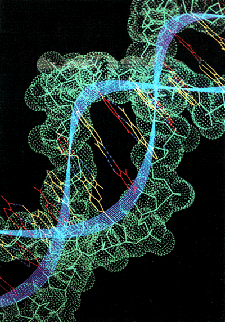
In recent years scientists have searched for the reason for this difference within our DNA. Recently this work has paid off and a gene for physical performance has been discovered.
|
The ACE 'Performance' Gene
Everybody has two copies of the ACE gene, however there are two versions (called alleles). One version has an extra section and is called the insertion allele (I), the other is called the deletion allele (D). If both your copies are insertion alleles (II) then you have an advantage in endurance (long distance) sport. While having the II version will not make a couch potato into superman, it may give endurance athletes the edge over lesser mortals.We are going to research how this gene affects how humans respond to altitude. There is already evidence that the majority of mountaineers who have climbed over 7,000m have the II version of the gene. We hope to uncover some of the reasons behind this by studying changes as 90 trekkers walk to 5,000m.
|


